Reported by Shreya Chakraborty, KICI TV News, July 7th, 2026
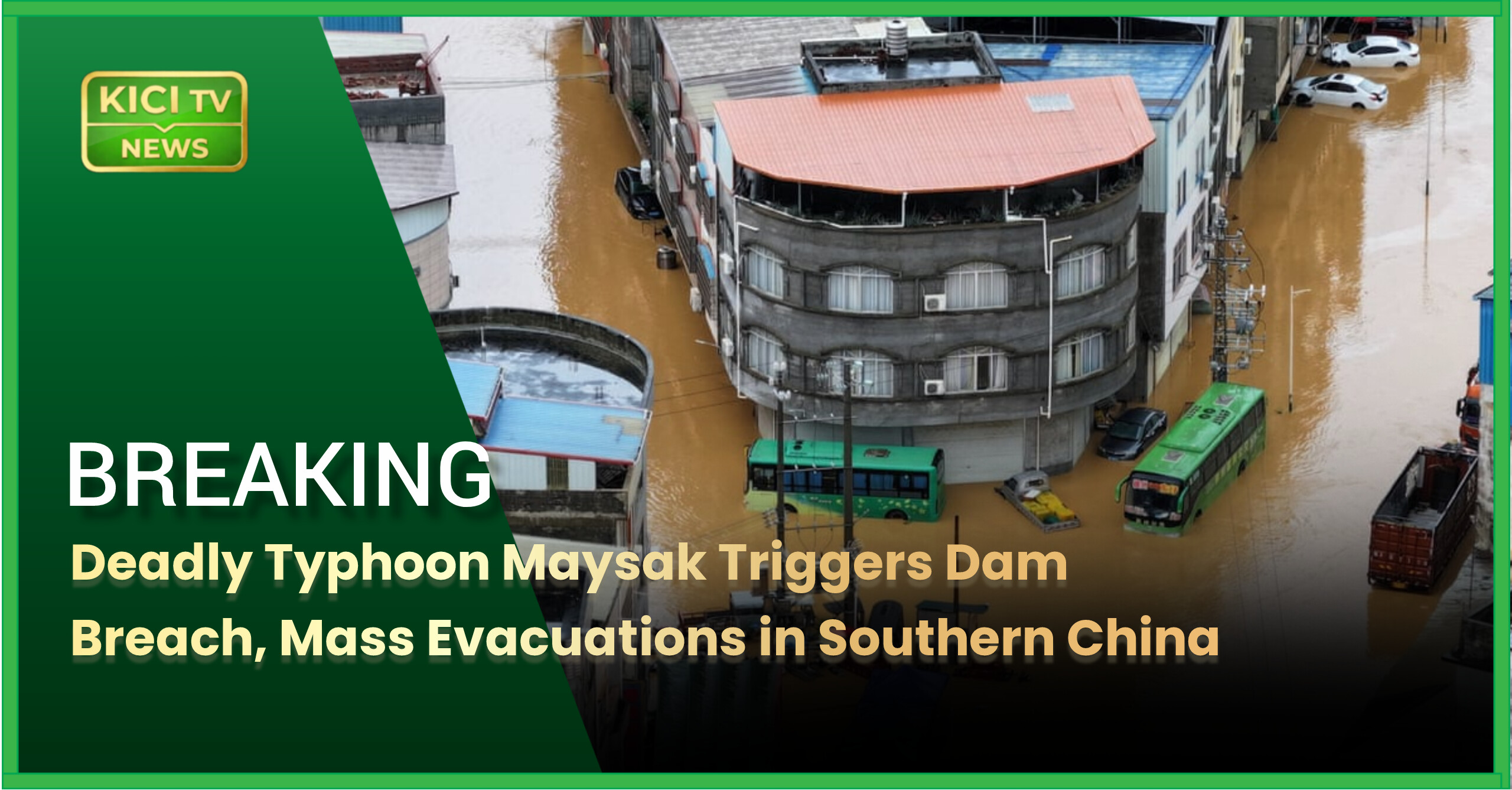
BEIJING — Southern China is facing a catastrophic humanitarian and infrastructure crisis today after the devastating remnants of Typhoon Maysak triggered unprecedented flooding, completely bursting a major dam wall in the Guangxi region. Local officials have confirmed fatalities, while over 54,000 residents have been forced to flee their homes in a desperate race against rapidly rising waters.
How and Where It Happened
Over the weekend, Typhoon Maysak—the 10th typhoon of the year—made a destructive double landfall, first striking China’s Hainan Island before slamming into northern Vietnam and churning directly into southern China’s Guangxi Zhuang Autonomous Region.
The catastrophic tipping point occurred on Monday at the mid-sized Liulan Reservoir, located in Hengzhou. Saturated by hours of relentless, record-breaking downpours, the reservoir’s capacity was entirely overwhelmed. At approximately 11:00 AM, the immense water pressure caused a massive structural failure, tearing a 50-meter (164-foot) gap directly through the concrete dam wall.
A colossal, brown torrent of muddy water violently escaped the breach, instantly engulfing downstream agricultural fields, tearing down utility poles, and turning local roads into roaring rivers.
Why It Happened: A Perfect Storm
Meteorologists and structural engineers point to a combination of extreme environmental factors that led to this disaster:
The Monsoonal Collision: The remnants of Typhoon Maysak collided directly with a powerful southwest monsoon, trapping a massive moisture system over southern China.
Saturated Soil & Extreme Volume: Some areas were battered with up to 33 centimeters (13 inches) of rain in mere hours. Because the ground was already completely saturated from previous summer rains, 100% of the deluge turned into immediate surface runoff, channeling straight into local river basins and aging reservoirs.
Aged Infrastructure: Built originally in 1960, the Liulan Reservoir simply could not withstand the violent volume of water generated by modern, climate-intensified hyper-storms.
Current Situation on the Ground
The situation in Guangxi remains critical. In Nanning, the regional capital, and nearby cities like Fangchenggang and Guigang, streets have turned into expansive lakes, with cars submerged up to their roofs.
Casualty Update: Local authorities have confirmed that at least 4 people have lost their lives in the immediate Nanning flooding, with several others still reported missing. Across the wider central and northern regions of China, parallel extreme weather systems triggered by the storm’s atmospheric wake have claimed an additional 16 lives due to tornadoes and landslides.
Over 93,000 people have been severely affected by the floods in Guangxi alone, with emergency shelters operating at maximum capacity to house the thousands of displaced families.
Emergency Precautions and Rescue Operations
In response to the unfolding disaster, the Chinese government has activated its highest-level Red Flood Alert for both Guangxi and neighboring Guangdong provinces.
Because traditional communication lines are completely down and many roads are entirely washed away, rescue teams are utilizing an innovative approach: heavy-duty drones are being used to fly over submerged villages to airdrop emergency food, fresh water, and medical supplies to residents stranded on rooftops. In some extreme instances, drones equipped with rescue ropes have successfully hoisted trapped individuals out of high-velocity currents.
What Lies Ahead
Chinese President Xi Jinping has called for “all-out efforts” to stabilize the breached dam zones, secure remaining infrastructure, and prioritize saving human lives.
However, the danger is far from over. The Ministry of Water Resources warned today that water levels at 70 monitoring stations across 55 different rivers remain dangerously above warning thresholds. To complicate matters further, meteorologists are already tracking Super Typhoon Bavi, which is currently churning across the Pacific and projected to strike eastern China later this week—threatening to drop even more water on a nation already pushed to its geographic limits.
This is a developing story. Stay tuned to KICI TV News Global for continuous live updates from the ground.