Reported by Shreya Chakraborty, KICI TV News, July 6, 2026
PARIS — As a brutal, record-breaking heatwave bakes Europe with temperatures smashing past 40°C (104°F), an unlikely household staple has completely vanished from French store shelves. It isn’t bottled water, air conditioning units, or high-tech fans. Instead, millions of desperate residents are panic-buying Blanc de Meudon—a humble, crushed chalk powder that costs just a few euros.
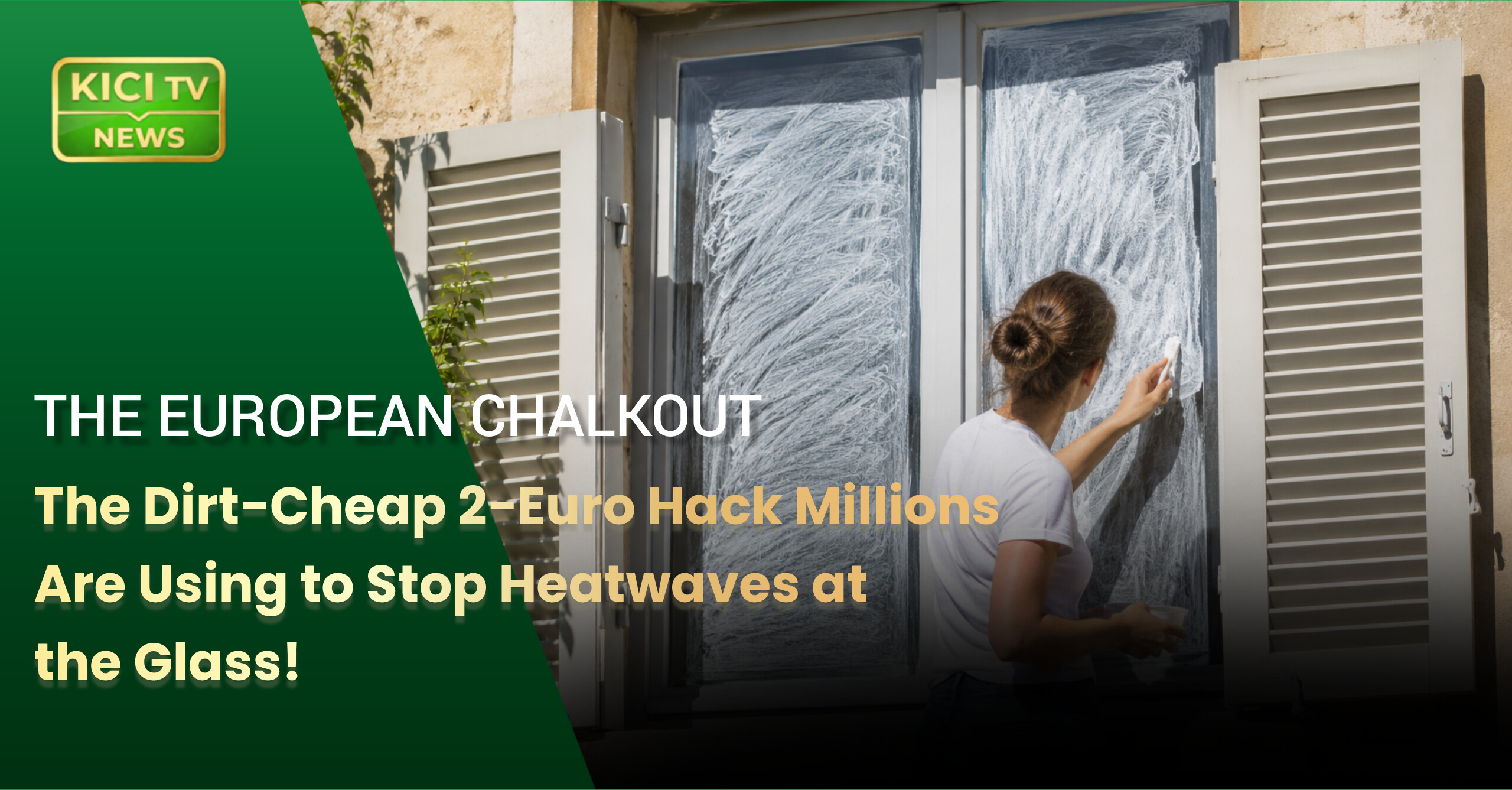
Across France, from residential flats in Paris to public schools in Nantes, windows are suddenly sporting a ghostly, milky-white glaze. It looks like a massive art project or an unfinished renovation, but it is actually a highly effective, low-tech shield against the scorching sun.
The Greenhouse Trap: Why Curtains Aren’t Cutting It
For generations, the go-to response to a heatwave has been to pull the indoor blinds or draw the curtains. But thermodynamics experts warn that this creates a major “air fryer” effect.
Once sunlight passes through your window glass, the thermal energy is already inside the room. Internal curtains simply trap that heat between the fabric and the pane, radiating it directly into your living space.
By slathering a temporary layer of chalk paste directly onto the outside of the window glass, homeowners are stopping the thermal energy before it even crosses the threshold.
The Hard Science Behind the Milky Glaze
The secret to this cheap DIY trick lies in the atomic composition of the chalk itself. Blanc de Meudon is primarily made of calcium carbonate (\text{CaCO}_3).
Unlike standard building materials that absorb solar radiation, calcium carbonate exhibits an incredibly high albedo—a scientific measure of a surface’s reflectivity.
- Sunlight Rejection: Chalk absorbs almost zero ultraviolet (UV) or near-infrared light, which are the primary bands of solar radiation responsible for carrying heat.
- Thermal Deflection: By creating an opaque, white barrier right on the glass, the mixture reflects the sun’s rays away from the building entirely.
- The Results: Early field testing and local reports indicate that this simple step can drop indoor temperatures by 3°C to 7°C without drawing a single watt of electricity.
From Window Chalk to ‘Le Cool Roofing’: The Radiative Cooling Revolution
This sudden craze highlights a massive shift toward passive cooling solutions as climate change intensifies. While air conditioners consume massive amounts of electricity and pump hot exhaust back into already sweltering cities, white pigments offer a clean alternative.
This is the foundational logic behind “Le Cool Roofing”—a growing urban planning trend where rooftops are coated in highly reflective white paint.
While standard commercial white paints can bounce back roughly 80% to 90% of sunlight, cutting-edge researchers (like those at Purdue University) have engineered ultra-white paints that reflect up to 98.1% of solar rays. These surfaces leverage passive radiative cooling, meaning they actually cool down below the surrounding ambient air temperature by radiating heat out at infrared wavelengths that pass straight through Earth’s atmosphere into deep space.
Slapping chalk on a window pane operates on a micro-scale of this exact concept. It is cheap, natural, completely biodegradable, and easily washes away with a sponge and water once the autumn breeze finally returns.
For a quick, practical demonstration on how to mix and apply this traditional paste to your own home glass, you can watch Blanc de Meudon Heatwave Guide, which shows exactly how the mixture is prepped to shield interiors from extreme summer temperatures.